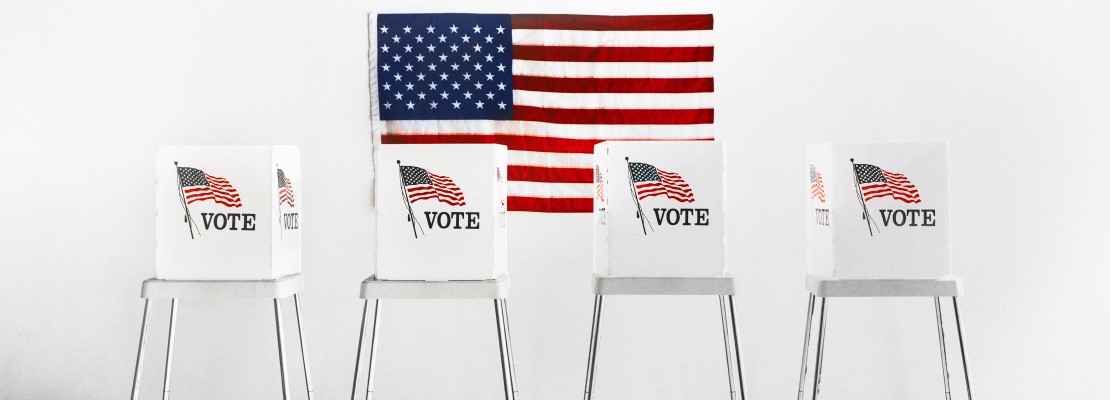
On March 1, 2016, both the Republican and Democratic parties will hold their primary elections here in Texas.
To take part in the primary, you must be registered to vote by today's deadline, Feb. 1. Check your registration status or learn how to register to vote by clicking here. The early voting period opens Feb. 16.
Any registered voter, regardless of party affiliation, may participate in either the Republican or Democratic primary (but not both). Also, voters may select any candidate they choose — again, regardless of party affiliation — in the general election on Nov. 8, 2016. For example, if you vote in the Republican primary, you are not bound to vote for the Republican candidates in the general election; you could still vote for Democratic, third-party, or independent candidates come November.

Here's the catch though:
in Texas, numerous contested races will be decided by the results of the primary election in March, making November's general election virtually meaningless in those particular districts. The reason for this is the manner in which district maps and boundaries are drawn through the redistricting process; districts are shaped — some would say "gerrymandered" — in such a manner as to favor whichever political party is in power at that time. As a result, some races will only attract candidates from a single political party, meaning that
the entire contest will be decided in March with no opposition on the ballot at all in November. In other races, there are candidates from different parties seeking the office, but the district maps so heavily favor one party over the other that it becomes almost a certainty that the race will be decided by a particular party's primary election in March, rather than the general election in November.
What does this mean for Texas voters? To be an informed voter, you should find out whether the contested races in your area are those in which the March 1 primary election is likely to determine the final outcome. Currently, here in Texas, many of the highest-profile election battles for legislative and State Board of Education (SBOE) seats are going to take place in the March 1 Republican primary election. That means that in certain cases, some educators who might typically vote in a Democratic primary election may wish to consider "crossing over" to vote in the Republican primary instead, where there may be a close battle between candidates for a critical seat on the SBOE or in the Texas legislature where so many education-related decisions will be made in 2017.
ATPE is a nonpartisan organization, and we do not endorse candidates. However, we strongly urge our members and all those with an interest in public education to find out where the candidates stand on education issues and to cast their votes in support of pro-public education candidates. In many of the contested races for legislative seats, it's fairly easy to ascertain that some candidates have a strong background and reputation for supporting public education, while other candidates have expressed decidedly anti-public education views and support for initiatives that are harmful to public education, such as private school vouchers and cutting education funding.
To help you identify those 2016 races in which the winners will be determined by the March primaries instead of the November general election, here is some additional information about races that are somewhat lopsided:
SBOE District 1
Incumbent Martha Dominguez (D) is not seeking re-election. Three Democratic candidates are vying for the open seat:
Georgina Perez,
Joe Fierro, and
Lynn Oliver. A third-party candidate,
Hugo Noyola, is also seeking a victory in November, but history shows us that third-party and independent candidates rarely win these races in the general election. In all likelihood, the winner of next month's Democratic primary will determine who takes this seat in 2017.
SBOE District 9
This district also features an incumbent, Thomas Ratliff (R), who is not seeking re-election. By contrast with District 1, this district is drawn in a manner that favors Republican candidates. There is a three-way race in the Republican primary between
Hank Hering,
Keven Ellis, and
Mary Lou Bruner. The winner of the Republican primary race between those three is most likely to become the winner of this seat after November's general election. Democrat
Amanda Rudolph and third-party candidate
Anastasia Wilford will also be on the ballot this fall, but they will be disadvantaged in this Republican-leaning district.
Senate District 1
This east Texas district holds an open seat on account of the retirement of Sen. Kevin Eltife (R). The
only candidates who have filed to run in this race are Republicans. This race will absolutely be decided by the outcome of the March 1 Republican primary election. The candidates are
Bryan Hughes (R),
David Simpson (R),
James K. "Red" Brown (R), and
Mike Lee (R).
Senate District 24
This is another Republican-oriented district in which the incumbent, Sen. Troy Fraser (R), is not seeking re-election. Six Republican candidates have filed to win this seat, and only one Democratic candidate (
"Jennie Lou" Leeder). Once again, the winner of the March 1 Republican primary election will most likely become the new senator in 2017. The Republican candidates are
Brent Mayes (R),
Dawn Buckingham (R),
Jon Cobb (R),
Reed Williams (R),
Ryan Downton (R), and
Susan King (R).
Senate District 26
In this race, a current state representative,
Trey Martinez Fischer (D), is challenging the current state senator,
Jose Menendez (D), in the Democratic primary election. Two third-party candidates will be on the ballot in November:
Fidel Castillo and
Scott Pusich, but this is another race in which the final outcome is likely to be determined by the March Democratic primary match-up because of the unlikelihood that a third-party candidate could win this race in November.
Senate District 27
The
only candidates in this race are the incumbent Sen.
Eddie Lucio Jr. (D) and his challenger,
O. Rodriguez Haro, III (D). This race will be decided by the March 1 Democratic primary election. The winner of the Democratic primary will be unopposed in November.
In the following Texas House races,
the outcomes will be determined by the primary election and not the general election because only candidates from a single party have filed to run in each of these districts:
House District 1 - to be decided by the Republican primary between incumbent Rep.
Gary VanDeaver (R) and challenger
George Lavender (R). No other candidates of any party have filed.
House District 2 - to be decided by the Republican primary between incumbent Rep.
Dan Flynn (R) and challenger
Bryan Slaton (R). No other candidates of any party have filed.
House District 4 - to be decided by the Republican primary between incumbent Rep.
Stuart Spitzer (R) and challenger
Lance Gooden (R). No other candidates of any party have filed.
House District 5 - to be decided by the Republican primary between
Cole Hefner (R),
Holly Coggins-Hayes (R),
Jay Misenheimer (R),
Philip Hayes (R), and
Randy Davis (R). No other candidates of any party have filed, but there may be a runoff in the Republican primary.
House District 7 - to be decided by the Republican primary between
David Watts (R) and
Jay Dean (R). No other candidates of any party have filed.
House District 8 - to be decided by the Republican primary between incumbent Rep.
Byron Cook (R) and challenger
Thomas McNutt (R). No other candidates of any party have filed.
House District 12 - to be decided by the Republican primary between incumbent Rep.
Kyle Kacal (R) and his two challengers,
Michael Stanford (R) and
Timothy Delasandro (R). No other candidates of any party have filed.
House District 14 - to be decided by the Republican primary between incumbent Rep.
John Raney (R) and his challenger
Jess Fields (R). No other candidates of any party have filed.
House District 17 - to be decided by the Republican primary between incumbent Rep.
John Cyrier (R) and his challenger
Brent Golemon (R). No other candidates of any party have filed.
House District 20 - to be decided by the Republican primary between incumbent Rep.
Marsha Farney (R) and her challenger
Terry Wilson (R). No other candidates of any party have filed.
House District 36 - to be decided by the Democratic primary between incumbent Rep.
Sergio Muñoz (D) and his challenger
Abraham Padron (D). No other candidates of any party have filed.
House District 37 - to be decided by the Democratic primary between incumbent Rep.
Rene Oliveira (D) and his challenger
Don De Leon (D). No other candidates of any party have filed.
House District 55 - to be determined by the Republican primary between incumbent Rep.
Molly White (R) and her challenger
Hugh Shine (R). No other candidates of any party have filed.
House District 58 - to be determined by the Republican primary between incumbent Rep.
DeWayne Burns (R) and his challenger
Philip Eby (R). No other candidates of any party have filed.
House District 59 - to be determined by the Republican primary between incumbent Rep.
J.D. Sheffield (R) and his challenger
Brent Graves (R). No other candidates of any party have filed.
House District 60 - to be determined by the Republican primary between
Kevin Downing (R) and
Mike Lang (R). No other candidates of any party have filed.
House District 73 - to be determined by the Republican primary between incumbent Rep.
Doug Miller (R) and his two challengers
Chris Byrd (R) and
Kyle Biedermann (R). No other candidates of any party have filed.
House District 75 - to be determined by the Democratic primary between incumbent Rep.
Mary Gonzalez (D) and her challenger
Chente Quintanilla (D). No other candidates of any party have filed.
House District 77 - to be determined by the Democratic primary between
Adolfo Lopez (D) and
Evelina "Lina" Ortega (D). No other candidates of any party have filed.
House District 81 - to be determined by the Republican primary between incumbent Rep.
Brooks Landgraf (R) and his challenger
Josh Crawford (R). No other candidates of any party have filed.
House District 84 - to be determined by the Republican primary between incumbent Rep.
John Frullo (R) and his challenger
Jim Landtroop (R). No other candidates of any party have filed.
House District 110 - to be determined by the Democratic primary between incumbent Rep.
Toni Rose (D) and her challenger
Sandra Crenshaw (D). No other candidates of any party have filed.
House District 116 - to be determined by the Democratic primary between
Diana Arevalo (D),
Martin Golando (D), and
Ruby Resendez (D). No other candidates of any party have filed.
House District 120 - to be determined by the Democratic primary between
Art Hall (D),
Barbara Gervin-Hawkins (D),
Byron Miller (D),
Latronda Darnell (D),
Lou Miller (D), and
Mario Salas (D). Due to the high number of candidates, this race will likely necessitate a runoff among the Democrats. However, no candidates of any other party have filed to run.
House District 124 - to be determined by the Democratic primary between incumbent Rep.
Ina Minjarez (D) and her challenger
Sergio Contreras (D). No other candidates of any party have filed.
House District 130 - to be determined by the Republican primary between
Kay Smith (R) and
Tom Oliverson (R). No other candidates of any party have filed.
House District 131 - to be determined by the Democratic primary between incumbent Rep.
Alma Allen (D) and her challenger
John Shike (D). No other candidates of any party have filed.
House District 139 - to be determined by the Democratic primary between
Jarvis Johnson (D),
Jerry Ford, Jr. (D),
Kimberly Willis (D), and
W. Randy Bates, Jr. (D). This race will probably necessitate a Democratic runoff, but no candidates of any other party have filed.
House District 148 - to be determined by the Democratic primary between incumbent Rep.
Jessica Farrar (D) and her challenger
Dave Wilson (D). No other candidates of any party have filed.
Additionally, there are several other legislative races in which the district is drawn in such a manner that it heavily favors one party over the others, including independent and third-party candidates. While the outcomes are not
certain, these races are also very likely to be decided by a single party's primary in March rather than by the November general election. They include the
Republican primary elections in House Districts 18, 92, 94, 99, 106, 121, 127, 128, and
150. Also in this category is the
Democratic primary election in House District 49, which features seven Democratic candidates, no Republican candidates, and only one third-party candidate.
As you can see, the primaries matter a great a deal in Texas. Whether you like it or not, there are 31 races that will absolutely be decided by a single party's primary this spring, and several other races in which November match-ups will be of little consequence. These are factors to consider when weighing your votes this spring. Learn more about the candidates by checking out their profiles using our search engine on the
2016 Races page here at Teach the Vote.
 Here's the catch though: in Texas, numerous contested races will be decided by the results of the primary election in March, making November's general election virtually meaningless in those particular districts. The reason for this is the manner in which district maps and boundaries are drawn through the redistricting process; districts are shaped — some would say "gerrymandered" — in such a manner as to favor whichever political party is in power at that time. As a result, some races will only attract candidates from a single political party, meaning that the entire contest will be decided in March with no opposition on the ballot at all in November. In other races, there are candidates from different parties seeking the office, but the district maps so heavily favor one party over the other that it becomes almost a certainty that the race will be decided by a particular party's primary election in March, rather than the general election in November.
What does this mean for Texas voters? To be an informed voter, you should find out whether the contested races in your area are those in which the March 1 primary election is likely to determine the final outcome. Currently, here in Texas, many of the highest-profile election battles for legislative and State Board of Education (SBOE) seats are going to take place in the March 1 Republican primary election. That means that in certain cases, some educators who might typically vote in a Democratic primary election may wish to consider "crossing over" to vote in the Republican primary instead, where there may be a close battle between candidates for a critical seat on the SBOE or in the Texas legislature where so many education-related decisions will be made in 2017.
ATPE is a nonpartisan organization, and we do not endorse candidates. However, we strongly urge our members and all those with an interest in public education to find out where the candidates stand on education issues and to cast their votes in support of pro-public education candidates. In many of the contested races for legislative seats, it's fairly easy to ascertain that some candidates have a strong background and reputation for supporting public education, while other candidates have expressed decidedly anti-public education views and support for initiatives that are harmful to public education, such as private school vouchers and cutting education funding.
Here's the catch though: in Texas, numerous contested races will be decided by the results of the primary election in March, making November's general election virtually meaningless in those particular districts. The reason for this is the manner in which district maps and boundaries are drawn through the redistricting process; districts are shaped — some would say "gerrymandered" — in such a manner as to favor whichever political party is in power at that time. As a result, some races will only attract candidates from a single political party, meaning that the entire contest will be decided in March with no opposition on the ballot at all in November. In other races, there are candidates from different parties seeking the office, but the district maps so heavily favor one party over the other that it becomes almost a certainty that the race will be decided by a particular party's primary election in March, rather than the general election in November.
What does this mean for Texas voters? To be an informed voter, you should find out whether the contested races in your area are those in which the March 1 primary election is likely to determine the final outcome. Currently, here in Texas, many of the highest-profile election battles for legislative and State Board of Education (SBOE) seats are going to take place in the March 1 Republican primary election. That means that in certain cases, some educators who might typically vote in a Democratic primary election may wish to consider "crossing over" to vote in the Republican primary instead, where there may be a close battle between candidates for a critical seat on the SBOE or in the Texas legislature where so many education-related decisions will be made in 2017.
ATPE is a nonpartisan organization, and we do not endorse candidates. However, we strongly urge our members and all those with an interest in public education to find out where the candidates stand on education issues and to cast their votes in support of pro-public education candidates. In many of the contested races for legislative seats, it's fairly easy to ascertain that some candidates have a strong background and reputation for supporting public education, while other candidates have expressed decidedly anti-public education views and support for initiatives that are harmful to public education, such as private school vouchers and cutting education funding.